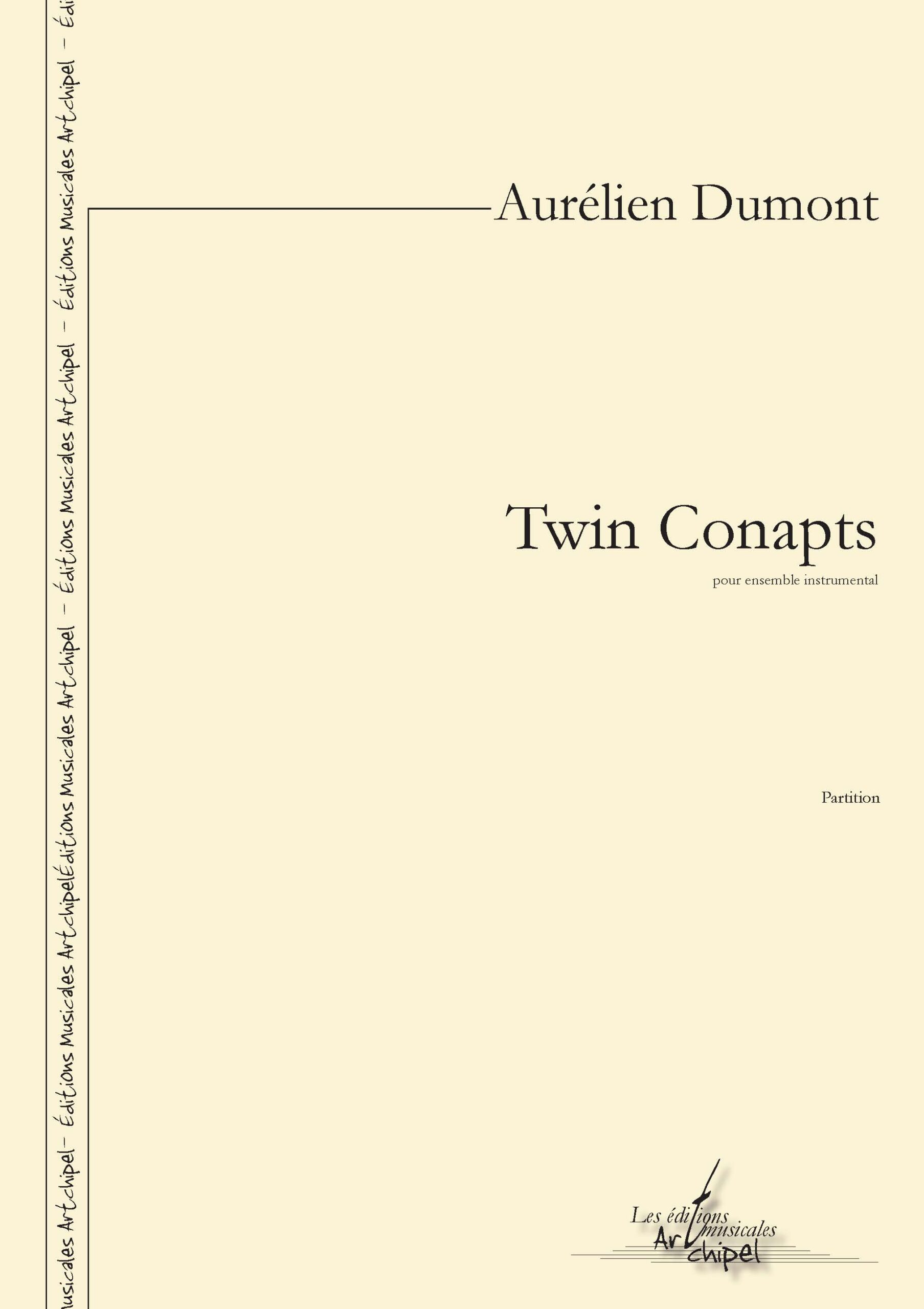
Twin Conapts
27,00 €
45,00 €
As composers, it seems to me that we share common goals with science fiction writers. Particularly in our propensity to create worlds, in our ability to move towards a philosophical dimension and also to leave a record in the imagination of the world in which we live.
This influence can be seen, for example, in the link I’ve been cultivating with the work of Antoine Volodine for nearly 15 years, whether structurally, with a transposition of literary forms stemming from Post-exoticism, or more directly through the adaptation of his works into musical theatre: Black village (2019), based on the novel by his heteronym Lutz Bassmann, or La nuit des mis bémols (in progress), based on the children’s novel by Manuella Draeger.
It was also while re-reading Aldous Huxley’s Brave New World that I decided to write, in 2023, The Steel Point Rasps & Rasps the Silence, for septet and electronics, a work that sets the novel’s dystopia in tension with biographical elements about its author, in particular his relationship with Stravinsky. Twin Conapts could thus be seen as the second piece in a cycle that began with this tribute piece. Here it is the figure of Philip K. Dick who is invited to take part, a man who shared with Stravinsky a deep love of music.
K. Dick’s universe is rich and infinitely complex. The term Conapt, an apocope of ‘condominium flat’, was introduced in his novel Ubik (1966). It refers to a kind of overconnected dwelling which, in one absolutely memorable scene, refuses to open to its tenant because he hasn’t paid for his coffee. It is this space that I have chosen to represent metaphorically in the piece, a space in which other Dickensian elements come into play: his love of John Dowland -how can we not mention Flow my Tears the Policeman Said (1970) – but also the influences that his work would leave on musicians such as Schulze, Zappa, Eno, Sonic Youth and Radiohead.
‘Reality is what refuses to disappear when you stop believing in it’, the writer tells us, long after a mystical experience, possibly under LSD, had convinced her that humanity had been living in a collective prison hallucination since the Roman Empire. So this relationship with a reality that eludes us is at the heart of Twin Conapts, particularly in the desire to create sound textures that blur the origin of the emitting sources, in the manner of a depraved Klangfarbenmelodie. I also tried to compose in a sensitive way the tormented temporal distortions characteristic of K. Dick’s universe, by musically symbolising certain temporal paradoxes and working on the extreme dilation and compression of certain musical objects.
To support these experiments, an unusual instrumental line-up has been chosen, using all the resources available to the Linea ensemble. The majority of the musicians use several instruments, allowing for unexpected combinations of timbre: Renaissance flutes rub shoulders with the contrabass flute, the theorbo with the electric guitar, the harpsichord with the synthesiser (using a ‘genetic’ model shaped by Artificial Intelligence), the sackbut with the trombone, the natural horn with the horn in F, medieval percussion with the drums, not forgetting the use of the majestic Baroque contrabassoon.
Several compositional spaces weave a labyrinthine form designed to lose contextual and aesthetic reference points for the different materials brought into play. These include Broken consorts, in reference to Renaissance music, Rock connections, representing Dickensian influences on popular music, and Conapt sounds, using more noisy and abstract sonorities.The work constantly re-engages the musical gesture in the articulation of a continuous, processual and hypnotic time with a narrative, discursive and fragmentary time. Repeated sounds are projected in a plurality of agogics by instrument or family of instruments; Twin Conapts attempts to displace listening through space and time.
Additional information
| Weight | 0,910 kg |
|---|---|
| Dimensions | 36,4 × 27,7 × 1 cm |
| Support | PDF, Paper |