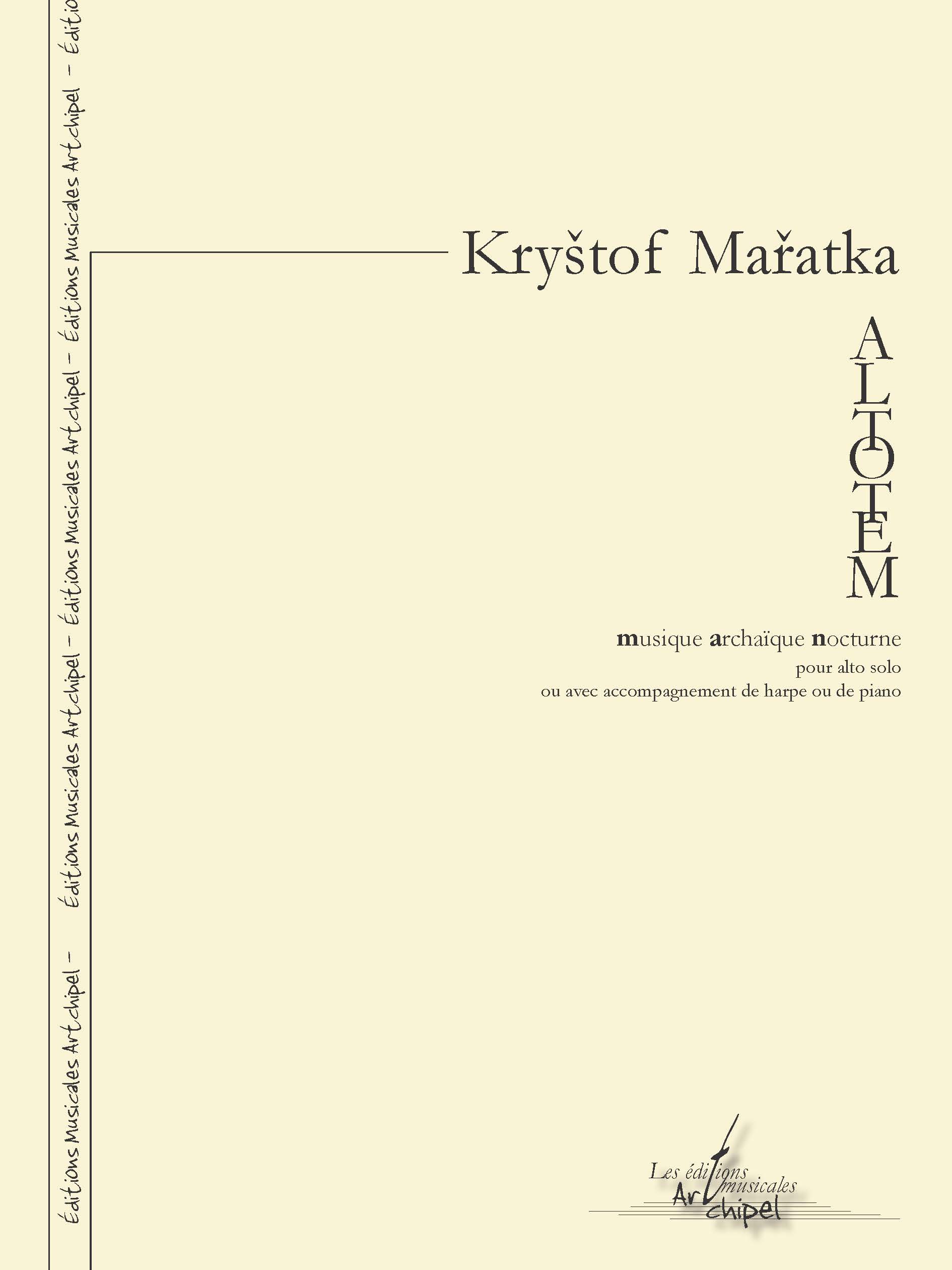
Altotem (nocturnal archaic music)
16,00 €
26,00 €
Altotem pays homage to one of the world’s foremost institutions preserving and showcasing humanity’s archaeological treasures—a magnificent collection of nearly three million artifacts, bearing witness to the lives and creativity of men and women over millions of years: the Musée d’Archéologie Nationale – Domaine de Saint-Germain-en-Laye (MAN).
Commissioned for violist Karine Lethiec as part of her MUSICoMAN project with Ensemble Calliopée, in scientific partnership with the MAN, the work embodies a musical resonance inspired by the museum’s iconic objects, collections, and spaces. It bridges ancestral traces and contemporary creation, transforming signs and imaginations into sound through the prism of the viola. This thematic exploration has long been central to Kryštof Mařatka’s creative work, deeply connected to prehistoric art. Some of his compositions push the boundaries of the imagination, evoking the sounds of the orchestra through a Paleolithic lens. He unites the origins of music with contemporary creation—a process he calls “origINnovation.”
The title Altotem is a neologism, merging alto and totem, evoking ritual objects, ancestors, and protection. The subtitle, musique archaïque nocturne (nocturnal archaic music), not only nods to the MAN (Musée d’Archéologie Nationale) but also sets an atmosphere—a journey into the past, the ancient, the primordial, and the elemental.
Mařatka describes altotem as an imaginary, unknown musical instrument: an ancient ancestor of the modern viola, its forgotten sonorities revealing the mysteries of the museum’s artifacts at nightfall, honoring and safeguarding them. To conjure this imaginary world, the viola takes center stage, shaping the entire musical discourse. Mařatka explores its sonic possibilities to the extreme—through timbre, texture, and color—leading him to create multiple versions of the work: for viola with harp, viola with piano, and solo viola.
In the viola and harp version, the harp envelops the viola in a resonant harmonic space, built from short ornamental motifs and enriched by microintervals achieved through a scordatura (lowering all E strings by nearly a quarter tone). This unique modal atmosphere evokes the sound of an archaic plucked string instrument.
In the viola and piano version, the composer employs a specific piano technique—playing without the pedal but sustaining notes by holding the keys, akin to organ playing. This approach highlights polyphony within the chords, crafting a harmonic universe that carries the viola’s narrative.
In the solo viola version, the viola part remains identical, its rich sonic palette bearing the full weight of the musical discourse. The work is slightly abbreviated in places to compensate for the absence of harmonic resonance from an accompanying instrument. The violist is invited to shape the relationship with time and resonance, adapting to the acoustics of the performance space. The piece unfolds in varied sections, introspective and enigmatic, awakening the strange mysteries of archaeological treasures as revealed by the altotem and its music.
Mařatka encourages performers to consult Karine Lethiec’s editorial notes for guidance on the technical and imaginative aspects of the work’s sonic world.
Additional information
| Weight | 0,510 kg |
|---|---|
| Dimensions | 32 × 24 × 1 cm |
| Support | PDF, Paper |